 Luxury Egypt
Abu Simbel: The Two Temples, the Ticket and the Sun Festival
Abu Simbel is the reason many travelers add a day to Aswan. Two rock temples cut for Ramesses II around 1264 BC stand on the shore of Lake Nasser, guarded by four 20 m colossi, and twice a year the rising sun reaches the inner sanctuary. This guide covers the temples themselves, the 1964 to 1968 rescue move, the sun alignment on 22 October and 22 February with its own ticket, and the practical details: the EGP 750 entry price, the card-only booth, the opening hours conflict and the drive from Aswan. The bookable tours are compared on Luxury Egypt.
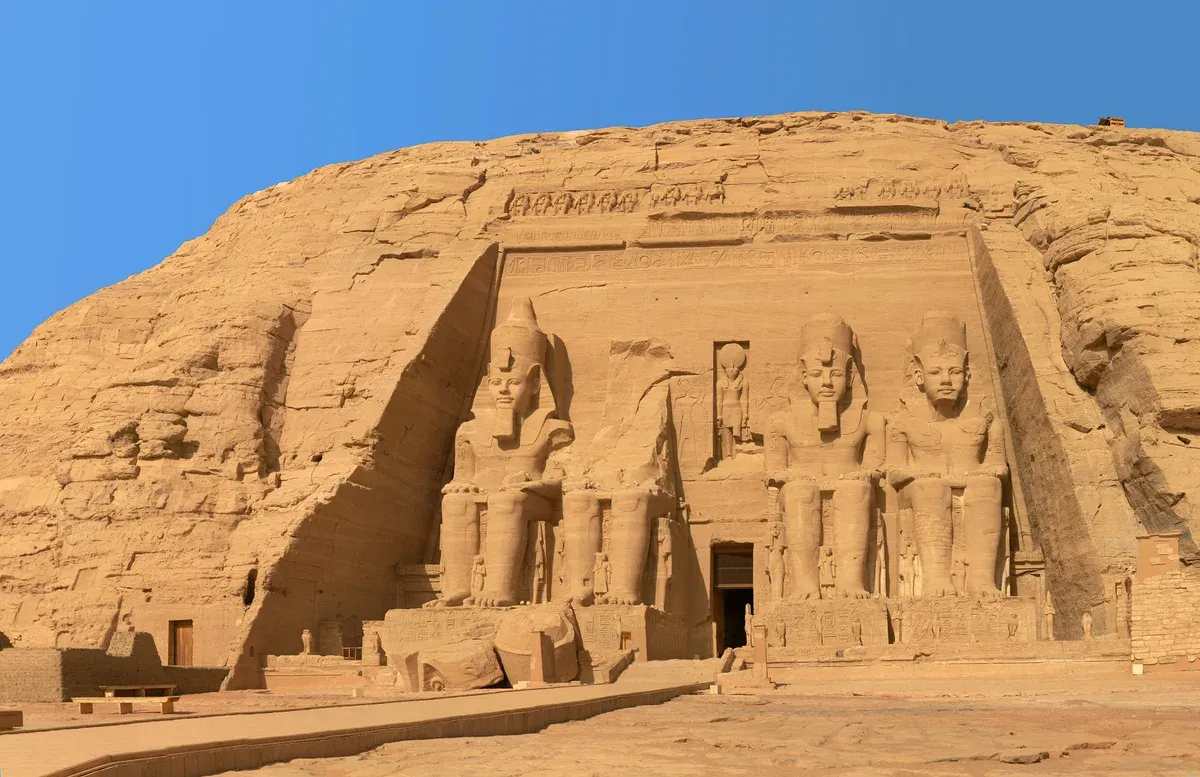
The Great Temple of Ramesses II at Abu Simbel with its four seated colossi. Photo: MatthiasKabel, CC BY-SA 3.0, via Wikimedia Commons
Quick answer Abu Simbel at a glance
A ticket to Abu Simbel costs EGP 750 for foreign adults and EGP 375 for students, and the site is open 6:00 to 17:00 on the ministry price list. The two temples of Ramesses II and Nefertari were cut from the rock around 1264 BC and moved 65 m uphill between 1964 and 1968 to escape the water of Lake Nasser. Most visitors come from Aswan, 3.5 to 4 hours each way by road, leaving around 4:00.
Key takeaways
- The sun reaches the inner sanctuary on 22 October and 22 February only, and those days need a special ticket of EGP 1,200 for foreign adults.
- The cheapest way to see Abu Simbel as part of a trip is the 4-day Nile cruise with Abu Simbel at $690 per person, which includes the temple, a 5-star ship and entrance fees.
- If you want a longer private itinerary that includes the temples, the 10-day Ultimate Egypt Nile Cruise at $4,700 plus a $25 charge added at checkout includes Abu Simbel on its route, with domestic flights included.
- For how the temples fit into the wider route, see the guide to a Nile river cruise and the best time to visit Egypt.
- Compare every itinerary side by side in the homepage comparison table, or start with luxury Egypt tours.
The Two Temples of Abu Simbel
Ramesses II began the twin temples around 1264 BC and finished them roughly 20 years later. Johann Ludwig Burckhardt rediscovered them in March 1813 and Giovanni Belzoni first entered the Great Temple on 1 August 1817, after centuries under sand.
The Great Temple of Ramesses II
The facade is 33 m high and 38 m wide, cut straight into the cliff, with four seated colossi of Ramesses II each 20 m (66 ft) tall. Below and between them stand smaller figures of family members, and above the door a statue of Ra-Horakhty. The facade is the first thing visitors photograph, and it is the view that made the rescue move famous.
Inside, the hypostyle hall measures 18 m by 16.7 m and its ceiling rests on eight Osirid pillars, each carved with the pharaoh in the pose of Osiris. The walls carry reliefs of battle scenes. Deeper in, a second hall leads to the sanctuary at the very back, which holds four seated figures: Ra-Horakhty, the deified Ramesses, Amun-Ra and Ptah. This is the room the sun reaches on the alignment days, and the layout explains why. The axis was cut so the dawn light would travel the full length of the temple twice a year.
The temple sits today under a concrete dome 55 m across and 19 m high, an artificial hill of about 300,000 tonnes of material covering it. From the forecourt, Lake Nasser stretches south, and the Sudan border lies roughly 20 to 40 km away depending on the source you believe.
The Small Temple of Hathor and Nefertari
Close to the Great Temple stands the second monument, dedicated to the goddess Hathor and to Queen Nefertari, who is personified as Hathor. It is rare in Egyptian architecture for a queen to be shown on the same scale as the king, and here she is. The facade has six standing figures about 10 m tall, four of Ramesses II and two of Nefertari.
The interior is smaller and plainer than its neighbor. A hall with Hathor-headed pillars leads to side chambers and a sanctuary with a statue of the goddess. Reliefs show the queen and king making offerings. The relocated temple sits under a protective dome 21 m across and 6.6 m high, covered by the same artificial hill as the Great Temple.
Sources conflict on the statue height. Wikipedia records Nefertari's statue at 4 m beside the Hathor figures, while one visitor guide puts all six figures at about 10 m. Both agree on the unusual point: a queen shown at monumental scale, which almost no other temple in Egypt does. The walk between the two temples is short and there is little shade.
The Move of 1964 to 1968
When the Aswan High Dam was completed in 1970, the reservoir behind it, Lake Nasser, would have risen up to 60 m over the original position of Abu Simbel and drowned the temples. Between 1964 and 1968 an international operation cut both monuments out of the cliff and rebuilt them higher up. The project finished 18 months ahead of schedule.
The figures for the move vary by source, and you should know the spread rather than one tidy number. Wikipedia says the temples were cut into 1,036 blocks, 807 from the Great Temple and 235 from the Small Temple, with the smallest block weighing 7 tonnes. One guide gives 1,042 blocks and another only says more than 1,000. On the lift, Wikipedia records the Great Temple moved 208 m inland and 65 m higher, while two guides say 180 m and about 64 m, or 65 m and 200 m. The cost is also split: Wikipedia gives US$41.7 million, one guide US$40 million.
What is not in dispute is the result. The temples stand on a new ridge above the water, the two domes hidden under a shaped hill so the setting still reads as natural rock. UNESCO inscribed Abu Simbel with the Nubian Monuments from Abu Simbel to Philae in 1979. Philae's own temples were moved separately to Agilkia Island between 1977 and 1979.
Key Figures for Both Temples
The table pulls together the main dimensions and dates for a visit, drawn from Wikipedia, the Egyptian ministry price list and visitor guides. Where sources disagree, both figures are shown so you can see the spread.
| Feature | Figure | Source |
|---|---|---|
| Great Temple facade | 33 m high, 38 m wide | Wikipedia |
| Colossi height | 20 m (66 ft) | Wikipedia |
| Small Temple figures | About 10 m (one source: 4 m for Nefertari) | Visitor guide and Wikipedia |
| Foreign adult ticket | EGP 750 (one guide: EGP 822) | Ministry list and visitor guides |
| Opening hours | 6:00 to 17:00 (other sources: 5:00 opening, last entry 16:00) | Ministry list and visitor guides |
| Distance from Aswan | About 230 km (other sources: 280 to 290 km) | Wikipedia and travel guides |
| Relocation | 1964 to 1968, 65 m up, 180 to 208 m back | Wikipedia and visitor guides |
The Sun Festival: 22 February and 22 October
Twice a year the first light of dawn travels deep into the Great Temple and lights the statues in the sanctuary. The dates are fixed on the calendar: 22 October and 22 February.
What Happens at the Alignment
The builders cut the temple axis so that on two mornings each year the sun crosses 55 m of rock and reaches the inner sanctuary. The light falls on three of the four seated statues, Ra-Horakhty, the deified Ramesses and Amun-Ra, and stays for about 20 minutes. Ptah, the god of the underworld, remains in shadow.
Nothing else is added on those mornings. There is no ceremony staged by priests, no music, no ritual. What you get is the same stone sanctuary that any visit shows you, lit from within by a shaft of sunlight instead of electric lamps, and expect a crowd. The day starts very early.
The sun reaches the sanctuary on the same two dates each year.
The Sun Festival Ticket
The two alignment mornings need a separate, more expensive ticket. The ministry price list shows the sun alignment ticket at EGP 1,200 for foreign adults and EGP 600 for students, against the normal EGP 750 and EGP 375. One independent guide quotes EGP 1,272 for the festival ticket, so carry some margin in your budget.
Crowds are the real price on the alignment mornings. If the alignment matters to you, book accommodation and transport well ahead. If it does not, an ordinary day is the calmer choice. For a trip built around the temples without the festival crowds, the 4-day Nile cruise with Abu Simbel includes the site at $690 per person, and the guide to the Nile river cruise explains how the boats reach it.
Normal Ticket Versus Festival Ticket
The table sets the ministry price list figures for an ordinary visit against the sun alignment days, with the conflicting guide figures noted.
| Ticket | Foreign adult | Student | When |
|---|---|---|---|
| Normal entry | EGP 750 | EGP 375 | Any open day |
| Normal entry (guide figures) | EGP 822 (PyramidsLand, Solo Backpacker) or about EGP 800 (Travel Tinker) | not stated | Any open day |
| Sun alignment | EGP 1,200 | EGP 600 | 22 February and 22 October |
| Sun alignment (guide figure) | EGP 1,272 | not stated | 22 February and 22 October |
Hours, Heat and Practical Notes
The ministry price list opens Abu Simbel from 6:00 to 17:00. Two guides disagree: one says the gates open at 5:00, another says last entry is at 16:00. The early opening fits the way nearly everyone visits, arriving on the 4:00 road convoy from Aswan, so plan on being first in line at dawn regardless of which figure holds.
The booth takes cards only, according to a 2026 visitor guide, so carry a card rather than counting on cash. Parking costs EGP 25 for a car, EGP 75 for a minibus and EGP 100 for a bus. Photography inside is allowed only with mobile phones, per Wikivoyage, and a drone is illegal anywhere in Egypt without Ministry of Defence permission, with fines of EGP 5,000 to 50,000.
Heat is the main physical challenge. Aswan's average summer highs stay above 40 C and its record is 51 C. Carry water and a hat outside. Few visitors stay more than a few hours on site and two hours is a reasonable minimum for both temples. The best time to visit Egypt guide has the month-by-month temperatures.
Sources: Egyptian Ministry of Tourism price list, Wikipedia: Abu Simbel temples, Wikivoyage: Abu Simbel
The Abu Simbel Temple Complex
A walk through the Abu Simbel temple complex with the history of the move to higher ground. Third-party video by Rick Steves' Europe. This site did not shoot it and has no relationship with the creator.
Getting to Abu Simbel: Road or Flight
Abu Simbel sits far south of Aswan near the Sudan border (sources give 230 to 290 km), and every visit starts there. You have two realistic ways in, and both leave early.
Road or Plane from Aswan
Most visitors come by road, in a convoy that leaves Aswan around 4:00, because the desert highway is closed to tourists from 17:00 to 5:00. The drive takes 3.5 to 4 hours each way, so a road day trip eats most of a day. Public buses also run, with departures at 4:00 and 11:00, and convoy buses must leave Abu Simbel by 16:00 at the latest. Foreigners generally cannot drive themselves and must use the convoy or a hired driver arranged through a local agency. Hotel-arranged minibuses from Aswan are listed at EGP 150 to EGP 350 each way, and a private car around EGP 2,500 return. The flight is faster: EgyptAir and Air Cairo flights from Aswan take about 45 minutes. For more on the river itself, see the guide to a Nile river cruise.
The table compares the two ways from Aswan. Drive and flight times come from the published sources cited on this page.
| Way | Time each way | Leaves | Notes |
|---|---|---|---|
| Road convoy from Aswan | 3.5 to 4 hours | About 4:00 | Highway closed to tourists 17:00 to 5:00, convoy buses out of Abu Simbel by 16:00 |
| Public bus from Aswan | About 3 hours | 4:00 and 11:00 | At least one daily convoy in each direction |
| Flight from Aswan | About 45 minutes | Not stated | EgyptAir and Air Cairo, Abu Simbel airport has a 3,000 m runway |
Tickets, Hours and Heat
The ministry price list shows Abu Simbel at EGP 750 for foreign adults and EGP 375 for students. A special ticket covers the 22 October and 22 February sun alignment days at EGP 1,200 for foreign adults and EGP 600 for students. Parking costs EGP 25 for a car, EGP 75 for a minibus and EGP 100 for a bus. One 2026 guide reports the ticket booth takes cards only, so carry a card rather than counting on cash. Opening hours are given as 6:00 to 17:00 on the ministry list, though other guides say the site opens at 5:00 or stops entry at 16:00, so aim for the earliest slot either way. Allow at least 2 hours on site.
Heat is the real constraint. Aswan's average summer highs stay above 40 C and its record is 51 C, so the 4:00 departure is not just about the road closure. November to March is the comfortable season, and the page on the best time to visit Egypt breaks the months down.
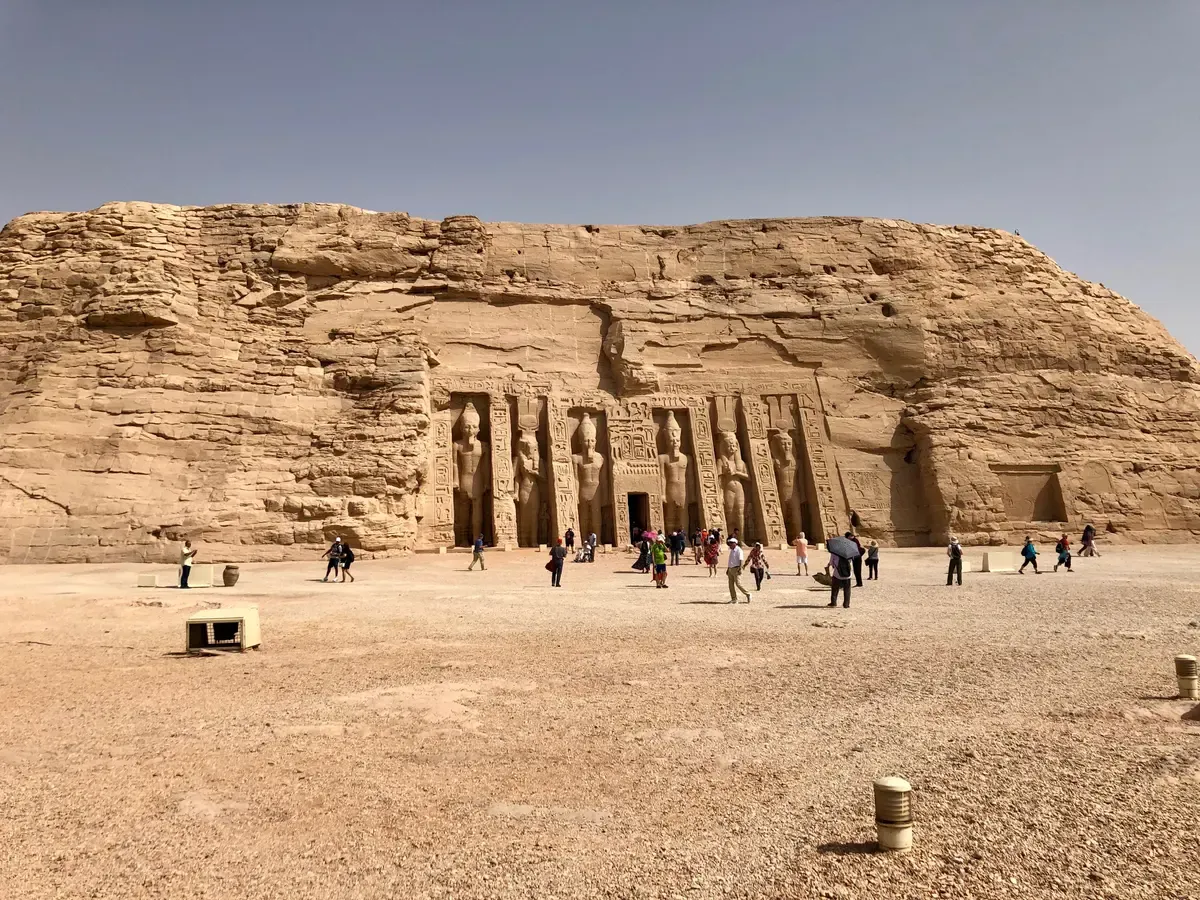
The Small Temple of Hathor and Nefertari at Abu Simbel, cut straight into the cliff. Photo: Warren LeMay from Cullowhee, NC, United States, CC0, via Wikimedia Commons
Tours That Include Abu Simbel
Some luxury Egypt tours build Abu Simbel into the price, others sell it as an optional extra, and the difference can be several hundred dollars.
What Each Tour Covers
The table lists every tour on this site that touches Abu Simbel, with the card price per person and how it is handled. Figures come from each tour's own listing.
| Tour | Price | Abu Simbel | How |
|---|---|---|---|
| 12-Day Luxury Egypt Nile Tour | $6,527 | Included | Abu Simbel on the route, domestic flights Cairo to Luxor and Aswan to Cairo included |
| 10-Day Ultimate Egypt Nile Cruise | $4,700 | Included | 4-night Nile cruise with Abu Simbel on the route, domestic flights included per the description |
| 9-Day Private Egypt Cruise Tour | $2,300 | Included | Cruise route with Abu Simbel, domestic flights included |
| 8-Day Private Egypt Nile Cruise Tour | $3,250 | Included | Abu Simbel on the route, flights Cairo to Aswan and Luxor to Cairo included |
| 8-Day Egypt Highlights with Balloon | $1,808 | Included | Cruise route with Abu Simbel, return flight to Cairo included |
| 4-Day Nile Cruise with Abu Simbel | $690 | Included | Luxor to Aswan cruise with an Abu Simbel trip by air-conditioned bus, departing 4:15 AM |
| 8-Day Cairo Aswan Luxor Private Tour | $1,800 | Optional extra | Sold on top of the tour price |
| 7-Day Private Egyptologist Tour | $1,500 | Optional extra | Optional flight to Abu Simbel, booked for an extra cost |
Who Should Pay for the Flight
The 45-minute flight from Aswan suits travellers short on time or visiting outside the cool months, since it avoids the 3.5 to 4 hours of driving each way. It costs extra on tours that do not include it, and on the 7-day private Egyptologist tour the optional Abu Simbel flight is booked for an unstated surcharge, so ask before booking. Road-based visits are built into tours such as the 9-day private Egypt cruise tour, which also bundles its domestic flights, so the honest comparison is not flight versus road but which tour already pays for the transfer.
On the 4-day cruise the Abu Simbel leg runs by air-conditioned bus, with a 4:15 AM departure.
Abu Simbel Tips: Do and Don't
Do
- Do take the 4:00 convoy, because the desert highway closes to tourists from 17:00 to 5:00 and you want the cool morning before Aswan's highs push past 40 C in summer.
- Do carry a card, because a 2026 guide reports the ticket booth takes cards only.
- Do allow at least 2 hours on site, which is the minimum suggested, while few visitors stay more than a few hours.
- Do buy the special EGP 1,200 ticket if you want the 22 October or 22 February sunrise alignment, since the standard EGP 750 entry is a separate ticket.
- Do book a tour that includes the transfer, because foreigners generally cannot drive themselves to Abu Simbel.
Don't
- Don't plan a late return, because convoy buses must leave Abu Simbel by 16:00 at the latest.
- Don't visit at midday in summer, because Aswan's average summer highs stay above 40 C and the record is 51 C.
- Don't rely on printed opening hours alone, because sources conflict between 6:00 to 17:00, a 5:00 opening and last entry at 16:00.
- Don't assume Abu Simbel is in your tour price, because on two of the tours here it is an optional extra charged on top.
Abu Simbel FAQ
Is Abu Simbel worth the trip from Aswan?
It is a long day, with 3.5 to 4 hours of driving each way and a 4:00 departure, or a 45-minute flight. If the 20 m colossi and the relocation story matter to you, tours such as the 4-day Nile cruise with Abu Simbel fold it into a wider trip.
How much is the Abu Simbel entrance ticket?
The ministry price list shows EGP 750 for foreign adults and EGP 375 for students, and the booth reportedly takes cards only. The cheapest way to combine it with the river is a cruise such as the 4-Day Nile Cruise with Abu Simbel.
What happens at the Abu Simbel sun festival?
On 22 October and 22 February sunlight travels 55 m into the Great Temple and lights three of the four sanctuary statues for about 20 minutes, leaving Ptah in shadow. Those dates need a special ticket of EGP 1,200 for foreign adults.
Can you drive yourself to Abu Simbel?
Foreigners generally cannot. You must use the convoy buses, a public bus leaving Aswan at 4:00 or 11:00, or a hired driver arranged through a local agency. Tours such as the 9-Day Private Egypt Cruise Tour handle the transfer for you.
How long do you need at Abu Simbel?
At least 2 hours, which is the suggested minimum, though few visitors stay more than a few hours. Plan the day around the convoy out of Abu Simbel by 16:00 at the latest.
Does a Nile cruise include Abu Simbel?
Some do and some do not. Abu Simbel sits far south of Aswan near Lake Nasser, so check whether the trip is included in the route. The 12-Day Luxury Egypt Nile Tour includes Abu Simbel on its route, and the Nile river cruise guide explains how the routes differ.