 Luxury Egypt
Valley of the Kings: Tickets, Tombs and What They Cost
The Valley of the Kings on Luxor's West Bank is where Egypt's New Kingdom pharaohs were cut into the limestone for nearly 500 years. This guide covers the base ticket and its conflicts, the extra tickets for Tutankhamun, Seti I and Ramesses VI, the camera rules, hours, heat, and which of the compared luxury Egypt tours actually bring you here. Figures come from the Ministry of Tourism price list and cited guides, and both sides of every conflict are shown. The bookable tours are compared on luxury Egypt tours.
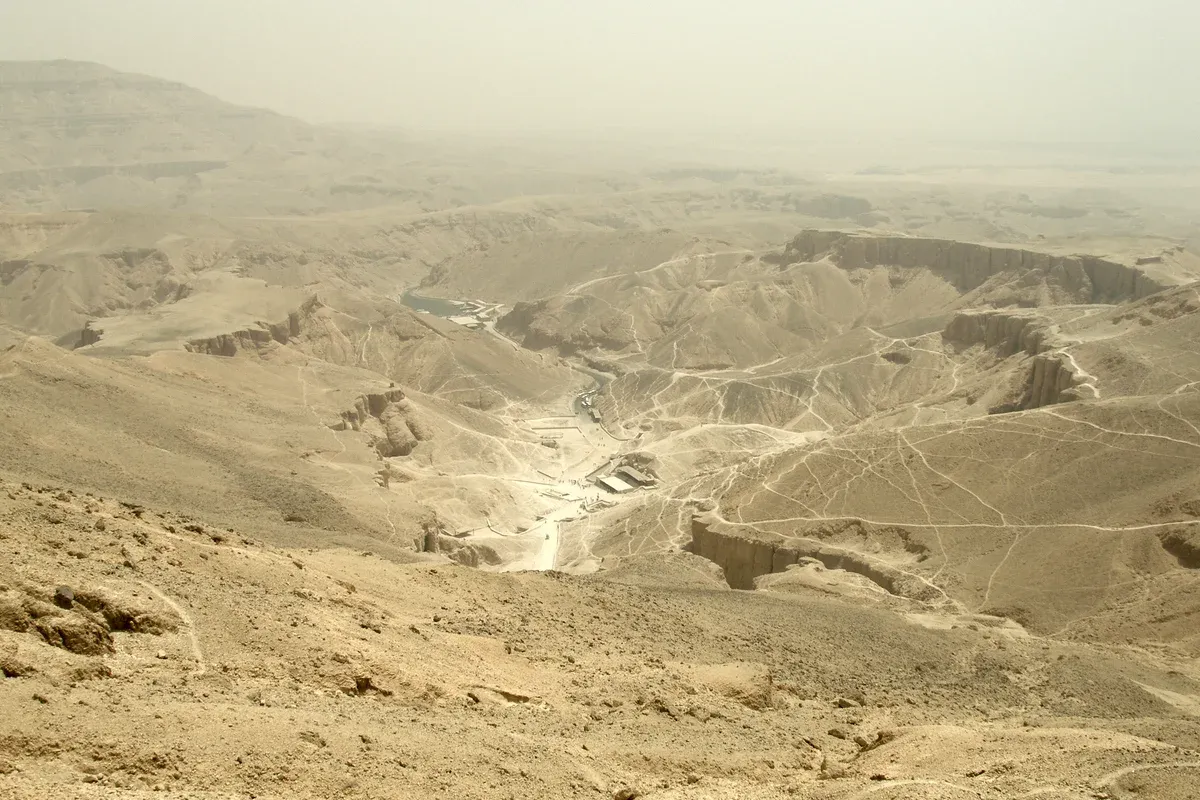
The Valley of the Kings seen from the cliffs above, with the visitor area in the middle of the dry valley. Photo: Vyacheslav Argenberg, CC BY 4.0, via Wikimedia Commons
Quick answer Valley of the Kings at a glance
The Valley of the Kings holds 65 known tombs and the ministry price list puts the base foreign adult ticket at EGP 750 for three tombs. Tutankhamun's tomb, Seti I's tomb and Ramesses VI's tomb each need separate tickets on top. The site opens 6:00 to 17:00 and the ticket office closes at 16:00.
Key takeaways
- Several of the compared private Egypt tours include entrance fees in their price, but always check whether the Tutankhamun and Seti I extras are covered.
- See how the valley fits the wider route in the classic Egypt itinerary, from Cairo and Giza down the Nile to Aswan.
- Most visitors reach the valley as part of a Nile river cruise between Luxor and Aswan, and the cruise pages own that topic.
- For the West Bank's other highlight, read the guide to the Luxor hot air balloon, which picks up in the early morning.
What the Valley of the Kings Is
A dry wadi on Luxor's west bank where New Kingdom pharaohs hid their tombs in the rock instead of building pyramids over them.
A Royal Burial Ground for Nearly 500 Years
The valley served as the royal burial ground for nearly 500 years, from the 18th to the 20th Dynasty, with burials running from about 1539 BC to 1075 BC. In ancient Thebes the east bank of the Nile held the living city and the west bank held the necropolis, which is why the tombs sit across the river from modern Luxor. The whole of Ancient Thebes, the valley included, became a UNESCO World Heritage site in 1979 and covers roughly 93 km2 on both banks of the Nile.
The premise was concealment rather than display. Corridors descend deep into the hillside, often well over 100 m, and the wall paintings carry the underworld books meant to guide the king through the night. Jules Baillet recorded more than 2,100 Greek and Latin graffiti in the tombs, left by Roman-era travellers who already came here as tourists.
How Many Tombs, and How Many Can You Actually Enter
The valley holds 65 known tombs and chambers, but only about 20 of them held the remains of kings. The rest belong to queens, princes and nobles. KV5, the tomb of the sons of Ramesses II, has more than 120 chambers and is the largest tomb in the valley. KV20, attributed to Hatshepsut, runs over 200 m and its burial chamber lies 97 m below the surface.
Here is the first conflict to know about. Wikipedia says about 18 tombs can potentially be opened to visitors, rarely all at once, while the Sailing Stone visitor guide puts the number usually open at about 12. Either way, on any given day you will choose from a short list of open tombs, not the full catalogue. A second numbering note: John Gardner Wilkinson introduced the KV system in 1827, and KV63 was only discovered on 10 March 2005, so new finds are recent. The valley sees an average of 4,000 to 5,000 visitors on most days, and tour guides are no longer allowed to lecture inside the tombs.
The Layout and Getting Around
The valley splits into the East Valley, where almost all open tombs sit, and the West Valley, which has one open tomb, that of Ay, and it needs a separate ticket.
Wikivoyage advises arriving early in the morning, especially in summer, and that advice matters twice over. Luxor's average monthly highs top 41 C in June and July, the hottest recorded temperature hit 50 C on 15 May 1991, and the tomb interiors trap heat and humidity. A morning start lets you walk several tombs before the day heats up.
Which Tombs to See
Your base ticket buys three tombs, and the best ones cost extra. Here is what each ticket buys and why it is worth it.
Tickets and What They Cover
The ministry price list sets the Valley of the Kings base ticket at EGP 750 for foreign adults and EGP 375 for students, and it covers three tombs of your choice among those open on the day. The Sailing Stone guide quotes EGP 240 per adult, an undated figure, so expect to pay the ministry figure at the window.
Open tombs rotate for conservation, so you cannot book specific tombs in advance. The table below compares the ticketed tombs most often discussed, with all prices from the ministry price list.
| Tomb | Ticket | Why go |
|---|---|---|
| Three base tombs (included) | EGP 750 adult, EGP 375 student | Covered by the base ticket, three of the open tombs |
| Tutankhamun (KV62) | EGP 700 extra | The famous tomb, four small chambers |
| Seti I (KV17) | EGP 2,000 extra | Usually regarded as the finest tomb in the valley |
| Ramesses V and VI (KV9) | EGP 220 extra | Carries the Book of Gates, the Book of Caverns and the Book of the Earth |
| Ay (West Valley) | Separate ticket, amount not stated | The only open tomb in the West Valley |
Tutankhamun's Tomb (KV62)
Tutankhamun reigned about 1332 to 1323 BC and died young, and his tomb was found by Howard Carter on 4 November 1922, when the first step down came to light. The burial chamber was reached on 16 February 1923. Clearing the tomb took ten digging seasons and finished in November 1930.
The tomb itself is small. KV62 has four chambers, with a burial chamber of 4 by 6.4 m, smaller than typical royal tombs. The antechamber measures 7.9 m by 3.6 m, the treasury 4.8 m by 3.8 m and the annexe 4.4 m by 2.6 m, all sitting about 0.9 m below the antechamber floor. The corridor is 8 m long and 1.7 m wide, and the entrance stair originally had sixteen steps. The burial chamber walls are painted with figures on a yellow background. The tomb held about 5,398 objects, including 413 shabtis and more than 200 pieces of jewellery, and the innermost coffin is 110.4 kg of solid gold. Expect wall painting rather than treasure.
Up to 1,000 people pass through KV62 on its busiest days, and a 1991 rainstorm flooded it, leaving about 7 cm of water through a fault in the ceiling. A replica of the burial chamber was completed in 2012 and opened in 2014. The EGP 700 extra ticket is worth it for the sense of scale, but on crowded mornings the chamber can feel like a queue with paintings. Note that DSLR cameras are forbidden inside KV62.
Seti I (KV17) and Ramesses VI (KV9)
KV17, the tomb of Seti I, was found by Giovanni Belzoni on 16 October 1817 and is usually regarded as the finest in the valley. It runs 137.19 m with seventeen chambers and side rooms, and its vaulted burial chamber has a ceiling of golden stars on deep blue. The decoration includes the Book of Gates, the Litany of Ra and the Amduat. The sarcophagus has been in Sir John Soane's Museum in London since 1824. KV17 is listed as open to visitors as of 2025, and the EGP 2,000 extra ticket is the single most expensive ticket in the valley.
KV9 was begun for Ramesses V and taken over by his uncle Ramesses VI, and the extra ticket is only EGP 220. It carries the Book of Gates, the Book of Caverns and the Book of the Earth, and 995 Greco-Roman graffiti have been recorded there, dated from the 1st century BC to the 4th century AD. Spoil from digging KV9 buried the entrance to KV62 under worker huts, which is partly why Tutankhamun survived. A full 3D model of KV9 was released in 2020.
On cameras there is a conflict to plan around. The Sailing Stone guide says a photography pass costs EGP 300 for three tombs, while the Flashpacking Family guide quotes about EGP 50 for a professional camera. Either way, DSLRs are forbidden in the Tutankhamun and Seti I tombs, so phone shots are the realistic option there.
If you would rather not handle tickets and touts at all, the 8-Day Cairo Aswan Luxor Private Tour at $1,800 per person includes entrance fees to all sites in its itinerary, and the dedicated page lists exactly what that covers.
Inside Tutankhamun's Tomb in the Valley of the Kings
A walk through the Valley of the Kings and inside Tutankhamun's tomb. Third-party video by Gimbal Walk TV. This site did not shoot it and has no relationship with the creator.
Tickets, Hours and Photography
Ticket prices at the Valley of the Kings are set in Egyptian pounds, and sources disagree on some of the figures. Here is what the official ministry price list shows and where the other guides differ.
The Base Ticket
The ministry price list shows the Valley of the Kings ticket at EGP 750 for foreign adults and EGP 375 for students. That ticket covers three tombs of your choice from the open list, and the extra tombs sit on separate tickets. An older guide, Sailing Stone, quotes the base ticket at EGP 240 for adults, which is well below the ministry figure. Prices at Egyptian monuments have risen in steps, so the undated guide figure probably reflects an earlier price. Treat EGP 750 as the number to plan around and expect the ticket office to charge it.
Students pay EGP 375 here. The base ticket does not cover the rest of the West Bank, so Hatshepsut Temple, the Valley of the Queens and Medinet Habu each have their own ministry ticket.
Extra Tickets: Tutankhamun, Seti I and Ramesses VI
Three of the best tombs cost extra on top of the base ticket. The ministry list prices Tutankhamun's tomb (KV62) at EGP 700, Ramesses V and VI's tomb (KV9) at EGP 220 and Seti I's tomb (KV17) at EGP 2,000 for foreign adults. Seti I is the steepest ticket in the valley, and the tomb is usually regarded as the finest in it. It runs 137.19 m with seventeen chambers and side rooms, and its burial chamber ceiling shows golden stars on deep blue. KV17 is listed as open to visitors as of 2025, but opening rotates, so check at the gate.
Budget for the base ticket plus your extras before you arrive. A visitor taking the base ticket, Tutankhamun and KV9 pays the EGP 750, EGP 700 and EGP 220 figures in tickets alone.
How Many Tombs Are Open
Two answers circulate. Wikipedia says only about 18 tombs can potentially be opened to visitors, and rarely all at once. The Sailing Stone guide says about 12 tombs are open on a given day. Both can be true, because the list of open tombs changes. The valley holds 65 known tombs and chambers in total, and only about 20 of them actually held the remains of kings. On any visit you will choose your three from a shorter list, usually the big Nineteenth and Twentieth Dynasty tombs such as KV6, 105 m long, or KV8, Merenptah's tomb at 160 m.
The West Valley counts separately. It has one open tomb, that of Ay, and it needs its own ticket.
Hours and Heat
The ministry list shows the site open from 6:00 to 17:00. The ticket office closes earlier, at 16:00, so a late arrival can find the gate shut even though the site is nominally open. Arrive early, especially in summer, as Wikivoyage advises. The valley sees an average of 4,000 to 5,000 visitors on most days, and crowds build through the morning.
The tombs sit at the head of a hot, dry wadi. Luxor's average highs top 40 C in June, July and August, so the walk can be punishing by late morning. Tour guides are no longer allowed to lecture inside the tombs, so your Egyptologist will brief you outside and let you read the walls yourself inside.
Camera Rules
The camera rules are the least settled part of a visit. The Sailing Stone guide says a photography pass costs EGP 300 for three tombs and that DSLR cameras are forbidden inside the Tutankhamun and Seti I tombs. The Flashpacking Family guide says a professional camera costs about EGP 50. The two figures differ by a wide margin and neither comes from the ministry list, so both are listed here as conflicting. Confirm the current rules at the ticket window before you shoot.
Whatever the pass costs, photography inside the tombs is controlled, and flash is the usual concern for the painted walls. The FCDO separately warns that professional photography equipment needs permits across Egypt, so serious gear needs paperwork beyond the valley itself. Drones are illegal without Ministry of Defence permission, with prison of up to 7 years or fines of EGP 5,000 to 50,000.
Valley of the Kings Ticket Prices at a Glance
The table gathers the ministry figures and the conflicting guide figures for the valley tickets. All sums are per foreign adult in Egyptian pounds.
| Ticket | Ministry price list | Other source | Notes |
|---|---|---|---|
| Base ticket, three tombs | EGP 750 | EGP 240 (Sailing Stone, undated) | Students EGP 375 |
| Tutankhamun, KV62 | EGP 700 | not stated | Extra ticket |
| Ramesses V and VI, KV9 | EGP 220 | not stated | Extra ticket |
| Seti I, KV17 | EGP 2,000 | not stated | Usually the finest tomb |
| West Valley, tomb of Ay | separate ticket | not stated | Amount not stated |
| Camera pass | not stated | EGP 300 for three tombs (Sailing Stone) or about EGP 50 (Flashpacking Family) | Sources conflict |
Sources: Ministry of Tourism and Antiquities price list, Wikipedia, Wikivoyage
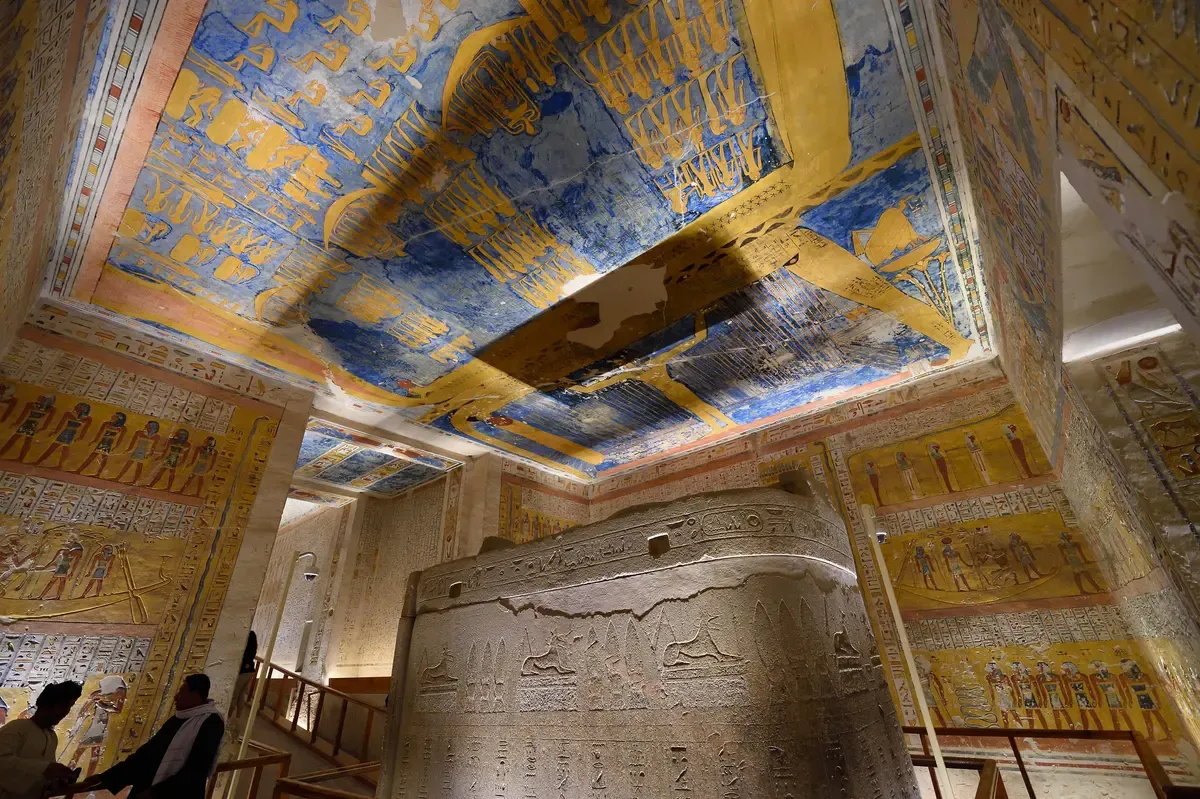
A painted burial chamber with its stone sarcophagus in a royal tomb in the Valley of the Kings. Photo: Tim Adams, CC BY 3.0, via Wikimedia Commons
The Rest of the West Bank
The Valley of the Kings sits on a West Bank that holds a full day of monuments. These are the four that pair best with it, with the ministry prices for each.
Hatshepsut Temple
The mortuary temple of Hatshepsut at Deir el-Bahari rises in three terraces against the cliff. It is 273.5 m long and 105 m wide, with a 1 km causeway running down to its valley temple. The upper terrace has 26 columns fronted by Osiride statues 5.2 m tall. The porticos carry reliefs of the expedition to Punt and of the queen's divine birth. Polish teams have restored the building since 1961.
The ministry price list shows the Temple of Hatshepsut at EGP 440 for foreign adults and EGP 220 for students. It sits on the same West Bank as the valley.
The Colossi of Memnon
The two Colossi of Memnon stand by the road at the edge of the cultivation. They are about 18 m tall with their platforms and weigh roughly 720 tons each, carved around 1350 BC for Amenhotep III's mortuary temple. An earthquake in 27 BC shattered the northern colossus, which then reportedly sang at dawn, drawing ancient travellers for centuries.
The ministry price list shows no ticket charge for the Colossi of Memnon, and the site is open 6:00 to 17:00. They stand on the West Bank, on the way to or from the other sites.
Valley of the Queens and Nefertari
The Valley of the Queens was called Ta-Set-Neferu, the Place of the Royal Children, and it was used for burials from about 1560 BC to 1130 BC. It holds 91 tombs in the main wadi and 19 in side valleys. The ministry price list shows the valley itself at EGP 220 for foreign adults.
The prize is QV66, the tomb of Nefertari, found by Ernesto Schiaparelli in 1904. Its burial chamber covers about 90 m2 with four pillars and a star-spangled ceiling. It needs a separate ticket, which the ministry list prices at EGP 2,500 (Wikipedia gives EGP 2,000 for 2023), the highest monument ticket on the West Bank, and visits are limited to 15 minutes. The tomb closed from 5 March 2024 to 27 October 2024 for urgent renovation, and visitor humidity and carbon dioxide remain a continuing threat to the paintings, so opening can change at short notice.
Medinet Habu and the Ramesseum
Medinet Habu, the mortuary temple of Ramesses III, is one of the most complete buildings on the West Bank. The temple runs about 150 m long with 48 rooms and more than 7,000 m2 of decorated wall reliefs. The Year 8 reliefs record the defeat of the Sea Peoples, and the south wall carries a liturgical calendar of 1,470 lines of hieroglyphs. A Coptic town grew inside its walls and was abandoned in the 9th century.
The ministry price list shows Medinet Habu at EGP 220 for foreign adults, the same figure as the Ramesseum. The Ramesseum, the mortuary temple of Ramesses II, covers about 10 hectares with a hypostyle hall of 41 by 31 m that had 48 columns. Its fallen colossus was about 19 m tall and an estimated 1,000 tonnes, and it inspired Shelley's poem Ozymandias. Reliefs on the walls show the Battle of Kadesh around 1274 BC.
West Bank Ticket Prices
This table lists the foreign adult prices from the ministry list for the monuments that pair with the Valley of the Kings. Student prices are half where the list shows them.
| Monument | Foreign adult | Students | Hours |
|---|---|---|---|
| Valley of the Kings, base | EGP 750 | EGP 375 | 6:00 to 17:00 |
| Hatshepsut Temple | EGP 440 | EGP 220 | not stated |
| Colossi of Memnon | free | free | 6:00 to 17:00 |
| Valley of the Queens | EGP 220 | not stated | not stated |
| Tomb of Nefertari, QV66 | EGP 2,500 | not stated | 15-minute visit |
| Medinet Habu | EGP 220 | not stated | not stated |
| Ramesseum | EGP 220 | not stated | not stated |
Filling a Full West Bank Day
A practical order is the valley at opening, then Hatshepsut, then Medinet Habu or the Ramesseum, with the Colossi on the road back. Add Nefertari in the Valley of the Queens if the EGP 2,500 ticket fits the budget. On the East Bank, Karnak and Luxor Temple close a day that most visitors reach on a Nile river cruise, which usually docks at Luxor with sightseeing built in.
Sources: Ministry of Tourism and Antiquities price list, Wikipedia
Seeing It on a Tour
Most visitors meet the Valley of the Kings on a booked tour rather than on their own tickets. Here is what the catalog tours actually include and what they leave out.
Which Tours Visit the Valley
Most tours on this site that reach Luxor list the Valley of the Kings by name. The pick for many travelers is the 8-Day Cairo Aswan Luxor Private Tour at $1,800 per person, a private group tour with a 3-night full-board cruise on a 5-star deluxe ship, both domestic flights and entrance fees to all sites in the itinerary. Abu Simbel is an optional extra on it, and a peak-period supplement of USD 200 per person applies from December 20 to January 2.
If a balloon ride matters, two options build one in. The 8-Day Egypt Highlights with Balloon at $1,808 per person includes a Luxor balloon ride on day 5, Abu Simbel and a 3-night 5-star cruise. The 9-Day Private Egypt Cruise Tour at $2,300 per person includes the balloon on day 6 with 3 cruise nights and 3 nights in Hurghada. Entry fees are included on both. For a cruise-only trip starting in Luxor, the 5-Day Ultra Deluxe Nile Cruise from $2,500 per person (the lowest of its options) includes a private Egyptologist and entry fees to historical sites on a full-board 5-day run to Aswan.
What a Tour Price Does and Does Not Cover
Check the inclusion lines before assuming anything. Entry fees are included on the $1,800, $1,808, $2,300 and $2,500 tours above, but that means the sites named in the itinerary. Extra tickets such as Tutankhamun's tomb at EGP 700 or Seti I's tomb at EGP 2,000 are not usually itemised, so ask the operator whether the standard three-tomb base ticket is what you get. Hotels are not part of the price on one listing: the 7-Day Private Egyptologist Tour at $1,500 per person excludes the Cairo hotel and both domestic flights, which the operator can book for an unstated extra cost.
None of these listings includes tips. Baksheesh, the Egyptian custom of tipping to show appreciation for service, applies at sites too, so carry small Egyptian pound notes.
Heat and the Early Start
Luxor's average monthly highs run from 22.8 C in January to 41.5 C in July, and the hottest recorded temperature is 50 C on 15 May 1991. Inside a rock-cut tomb with no airflow, those numbers feel worse than they read. Starting at opening, 6:00, is the way to beat the heat. Wikivoyage advises arriving early in the morning, especially in summer, and the average of 4,000 to 5,000 visitors a day backs the advice up.
Winter is the comfortable season. Wikivoyage calls November to March the most comfortable months for travel in Egypt, and Khamsin sandstorms between March and May can raise temperatures by up to 20 C in two hours with winds up to 140 km/h. Bring water, a hat and shoes that handle gravel and steps.
Tours That Include the Valley of the Kings
The table compares the catalog tours whose routes reach Luxor and the West Bank. Prices are the US dollar card prices per person, and the included lines come from each listing.
| Tour | Price | Days | What it adds around the valley |
|---|---|---|---|
| 8-Day Cairo Aswan Luxor Private Tour | $1,800 | 8 | 5-star deluxe hotel and ship, flights, entrance fees, Abu Simbel optional |
| 8-Day Egypt Highlights with Balloon | $1,808 | 8 | Balloon on day 5, Abu Simbel, 5-star cruise |
| 5-Day Ultra Deluxe Nile Cruise | $2,500 | 5 | Luxor to Aswan, private Egyptologist, entry fees |
| 9-Day Private Egypt Cruise Tour | $2,300 | 9 | Balloon on day 6, 3 cruise nights, Hurghada |
| 12-Day Luxury Egypt Nile Tour | $6,527 | 12 | Domestic flights, licensed Egyptologist, 5-star hotels, Abu Simbel included |
Frequently Asked Questions
How much does it cost to visit the Valley of the Kings?
The ministry price list shows the base ticket at EGP 750 for foreign adults and EGP 375 for students, covering three tombs. Tutankhamun's tomb costs an extra EGP 700, Ramesses V and VI EGP 220 and Seti I EGP 2,000. A camera pass is quoted at EGP 300 for three tombs by one guide and about EGP 50 by another, so the sources conflict. See the full breakdown in Tickets, Hours and Photography.
How many tombs are open in the Valley of the Kings?
Two figures circulate. Wikipedia says about 18 of the 65 known tombs and chambers can potentially be opened, rarely all at once, while the Sailing Stone guide says about 12 are open on a given day. The Ministry of Antiquities rotates tombs, so expect to choose your three from a list that changes. The background is in what the valley is.
What is the most famous tomb in Egypt?
Tutankhamun's tomb, KV62, is the most famous. Howard Carter found its first step on 4 November 1922, and the tomb held 5,398 objects including an innermost coffin of 110.4 kg of solid gold. It costs an extra EGP 700 beyond the base ticket, and up to 1,000 people pass through it on its busiest days. More on the pharaoh and the find is in the tombs of the valley.
Can you take photos inside the Valley of the Kings tombs?
Photography inside the tombs is controlled, and the camera pass price is disputed: EGP 300 for three tombs per one guide, about EGP 50 for a professional camera per another. DSLRs are forbidden in the Tutankhamun and Seti I tombs, and guides can no longer lecture inside the tombs at all. The details are in Camera Rules.
Is the Valley of the Kings included in a Nile cruise?
Cruises between Luxor and Aswan start or end in Luxor, and the catalog tours list entry fees for the sites in their itineraries. The 5-Day Ultra Deluxe Nile Cruise at $2,500 per person starts in Luxor with a private Egyptologist and entry fees included. Compare the options in Seeing It on a Tour.
What else is worth seeing on the Luxor West Bank?
Hatshepsut Temple at EGP 440, the free Colossi of Memnon, Medinet Habu at EGP 220 and the Valley of the Queens at EGP 220, with Nefertari's tomb at EGP 2,500 and a 15-minute visit limit. Most pair the valley with two or three of these in one morning. The figures are gathered in The Rest of the West Bank.