 Luxury Egypt
Dahabiya Nile Cruise: What It Is and What It Costs
A dahabiya Nile cruise is the slow way to sail the river between Luxor and Aswan. The boat is a shallow-bottomed river boat with two or more sails and no propeller. This page explains what a dahabiya is, where the word comes from, and how the bookable dahabiya trips in this comparison, priced from $1,100 and $1,750, differ from the 5-star cruise ships on the same water. For the wider picture of routes, seasons and ship classes, start with the guide to a Nile river cruise and the comparison of luxury Egypt tours.
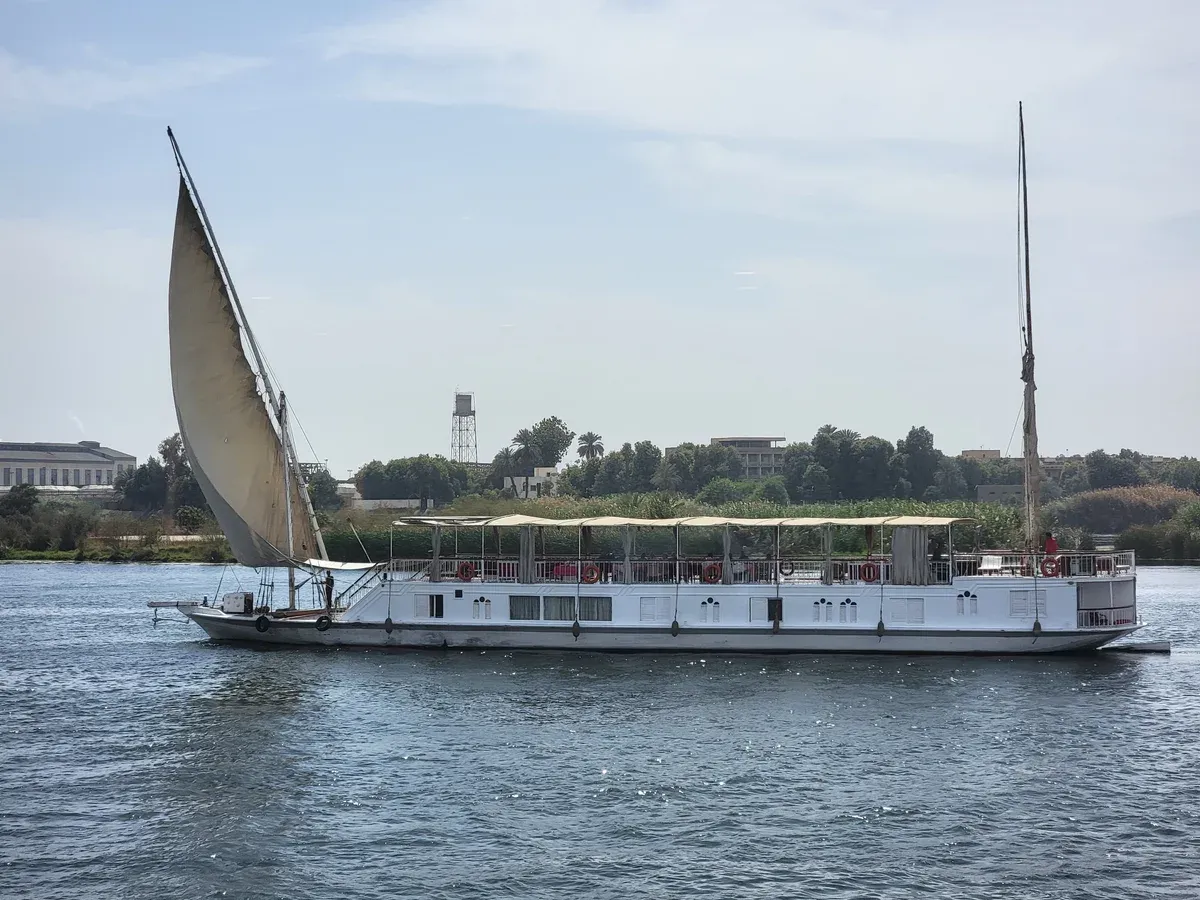
A white dahabiya with a lateen sail on the Nile. Photo: Votpuske, CC BY-SA 4.0, via Wikimedia Commons
Quick answer The short answer
A dahabiya Nile cruise costs from $1,100 (4 days, Aswan to Luxor) or $1,750 (5 days, Luxor to Aswan) per person in this comparison. A dahabiya is a shallow sailing boat with two or more sails and no propeller. It is towed by a diesel tugboat when the wind fails. The 4-day trip calls at Gebel el-Silsila.
Key takeaways
- The cheapest dahabiya here is the 4-Day Luxury Dahabiya Cruise, which sails from Aswan to Luxor and calls at Gebel el-Silsila.
- The full-length option is the 5-Day Dahabiya Nile Cruise, a private trip from Luxor to Aswan with all entrance fees included.
- Prefer a big ship? Compare the dahabiya with 5-star cruises in the comparison table on the homepage.
- Timing matters for any sailing trip, so check the best time to visit Egypt before you book.
What a Dahabiya Is
The dahabiya is the oldest form of Nile tourist travel still sailing today, and it is nothing like the 300-plus cruise ships on the river.
The Boat Itself
A dahabiya, sometimes spelled dahabeah, is a shallow-bottomed, barge-like river boat with two or more sails. Modern ones have no propeller. When the wind drops or the sails cannot make headway, a diesel tugboat tows the vessel, and a diesel generator on board supplies the electricity. That is the whole secret of the boat: it drifts with the river rather than driving through it, so a dahabiya Nile cruise runs at the pace of the current and the breeze rather than an engine schedule.
The word comes from the Arabic for the golden one, a name that dates back to the gilded state barges of medieval rulers. Do not confuse a dahabiya with a felucca. A felucca is the small lateen-sailed boat you see everywhere on the river, typically carrying ten passengers with a crew of two or three, and it is a small open boat rather than a floating hotel. A dahabiya is a full cruise vessel with cabins, a dining area and crew, but built at a scale closer to a large private house than a hotel tower.
Because the boats are small, the trade-offs are real. None of the listings in this comparison state cabin sizes or facilities, so check each card before you book. What you get instead is quiet: a mooring away from the crowds of cruise ships, deck space measured in metres of calm, and a river that sounds like wind and water rather than diesel engines.
- Two or more sails, shallow hull, no propeller
- Towed by a diesel tugboat when the wind fails
- A diesel generator provides power on board
- Cabin sizes and facilities are not stated in the listings
The History
Until the 1870s, the dahabiya was the standard way for tourists to travel the Nile. Every visitor who wanted to see Thebes, Edfu or Philae chartered one for the long haul up the river. John Gardner Wilkinson described hiring a dahabiya in his 1847 guide, so the practice was well established by mid-century. The prices were serious. A forty-day Cairo to Luxor round trip by dahabiya cost about GBP 110 in 1858, and a fifty-day trip to Aswan cost about GBP 150, sums that put the boat out of reach of most travellers.
Change came with steam. Thomas Cook pioneered Nile steamboat tourism in 1869, hiring two steamboats and cutting the Cairo to Aswan trip to about three weeks, and in 1870 Cook became the appointed agent for all Nile passenger traffic. By 1900, steamboats and railways had pushed the dahabiya into a niche: a luxury for the wealthy. Historic cruises of that era ran 20 to 21 days from Cairo to Aswan, far longer than the 4 and 5 day trips sold today.
The most famous dahabiya passenger was the writer Amelia Edwards. She and Lucy Renshaw sailed the Nile by dahabiya in the winter of 1873 to 1874 and stayed six weeks at Abu Simbel. Edwards published A Thousand Miles up the Nile in 1877, co-founded the Egypt Exploration Fund in 1882, and left GBP 2,500 to found a chair of Egyptology at University College London. Her book still shapes how people imagine a Nile sailing, and it describes a river journey that the modern dahabiya cruise keeps alive at a much shorter length. Modern Nile cruises mostly start at Luxor and run to Aswan, a stretch of about 214 to 220 km by road depending on the source, and that is the route the dahabiya trips in this comparison follow.
Sources: UK FCDO travel advice: Egypt, Wikipedia: Egypt
Dahabiya or 5-Star Ship
The honest comparison comes down to what you trade: a dahabiya buys quiet and small-group moorings, and a 5-star ship buys a set itinerary, with the $690 cruise priced below both dahabiyas.
Price and Route Comparison
The table below compares the dahabiya trips in the catalog with two 5-star ship cruises on the same stretch of river. Prices are the per-person card prices in US dollars taken from each listing on this site, and the nights and direction come from each tour record. The 4-Day Nile Cruise with Abu Simbel is the cheapest cruise here at $690, and it includes Abu Simbel, which neither dahabiya listing states.
The 5-Day Ultra Deluxe Nile Cruise is the most expensive of the four, from $2,500, and is a private trip on a 5-star ultra deluxe ship with a private Egyptologist and entry fees. Between them sit the two dahabiyas, at $1,750 for 4 nights sailing Luxor to Aswan and $1,100 for 3 nights sailing Aswan to Luxor. Every trip here leaves flights, hotels and any Cairo stay to you, and the Nile river cruise guide explains how a cruise slots into a longer itinerary.
| Cruise | Price | Boat | Nights | Direction |
|---|---|---|---|---|
| 5-Day Dahabiya Nile Cruise | $1,750 | 5-star dahabiya | 4 | Luxor to Aswan |
| 4-Day Luxury Dahabiya Cruise | $1,100 | Dahabiya | 3 | Aswan to Luxor |
| 5-Day Ultra Deluxe Nile Cruise | $2,500 | 5-star ultra deluxe ship | 4 | Luxor to Aswan |
| 4-Day Nile Cruise with Abu Simbel | $690 | 5-star ship | 3 | Luxor to Aswan |
Who Each Option Suits
The $690 small-group cruise suits travellers who want the temples at the lowest cost and do not mind a ship with up to 18 guests. It is the only trip of the four that includes Abu Simbel. The $2,500 ultra deluxe cruise suits travellers who want a private group, a private Egyptologist and full board on a top-class ship, and who value onboard facilities over mooring at quiet banks. It costs more than either dahabiya.
The $1,750 private dahabiya suits travellers who want the whole Luxor to Aswan run by dahabiya, an Egyptologist during the journey, all entrance fees between the two cities, and a private group, and who accept that a peak-period fee applies from December 20 to January 7 in an amount the listing does not state. The $1,100 dahabiya suits travellers on a smaller budget who are happy with a listing that does not say whether the group is private and want to sail from Aswan to Luxor, the direction Wikivoyage recommends for a felucca trip because of the current. It is the cheapest dahabiya here and the only one that stops at Gebel el-Silsila, a quarry site big ships pass.
Two cautions apply to all four. None includes domestic flights, so budget the Cairo to Luxor or Cairo to Aswan legs yourself, roughly a 3h48m door-to-door journey to Aswan or 3h13m to Luxor by air. And be realistic about the dahabiya pace: a sailing boat with 4 nights covers the same river a 5-star ship covers faster, and if a packed schedule matters more than the river itself, the ship is the better answer. Locks on the Nile close from April to mid-October for water management, which can force transfers between boats, so confirm how your operator handles that period whichever boat you pick.
Sailing the Nile on a Dahabiya
What to know before sailing the Nile on a dahabiya, from cabins to the daily routine. Third-party video by Wander Onwards. This site did not shoot it and has no relationship with the creator.
Where a Dahabiya Stops
The dahabiya route follows the classic Luxor to Aswan corridor, and the 4-day trip adds a stop at Gebel el-Silsila.
Gebel El-Silsila and the Small Stops
The clearest example is Gebel el-Silsila, which the 4-Day Luxury Dahabiya Cruise includes on its run from Aswan to Luxor. The site lies 65 km north of Aswan between Edfu and Kom Ombo, where the Nile narrows between sandstone cliffs. More than 120 quarries line the banks, and their sandstone supplied some of the most famous buildings in Egypt: Karnak, Luxor Temple, Medinet Habu, Kom Ombo and the Ramesseum all drew stone from here. The rock-cut Speos was created under Hatshepsut and decorated in the Ramesside period, four royal stelae stand south of it, and the Temple of Kheny was rediscovered in 2015 at about 80 by 40 m. In February 2019, archaeologists found two unfinished ram-headed sphinxes at the site.
The other dahabiya stops are the classic ones, with moorings at quieter times than the cruise-ship crowds. At Edfu, the Temple of Horus is 36 m high, 79 m long and 76 m wide, among Egypt's best preserved, and it was buried under about 12 m of sand until Mariette's excavation from 1860. Entry costs EGP 550 for foreign adults on the ministry price list, open 7:00 to 17:00. Kom Ombo, about 50 km north of Aswan, has a double temple with two entrances for two gods, built mainly between 180 and 145 BC, with a relief thought to show the first depiction of surgical instruments. Entry is EGP 450 for foreign adults, open 7:00 to 21:00. Esna sits about 55 km south of Luxor, its temple ticket EGP 200, and its barrage locks regularly delay cruise ships.
At either end of the route, Luxor and Aswan hold the biggest sites. Neither dahabiya trip lists Abu Simbel, so if it matters, plan extra days in Aswan or look at the 4-Day Nile Cruise with Abu Simbel. For a fuller stop-by-stop route, see the classic route guide on the homepage, and for timing, remember the preferred cruise season is October to February while average highs in Luxor and Aswan stay above 40 C in summer.
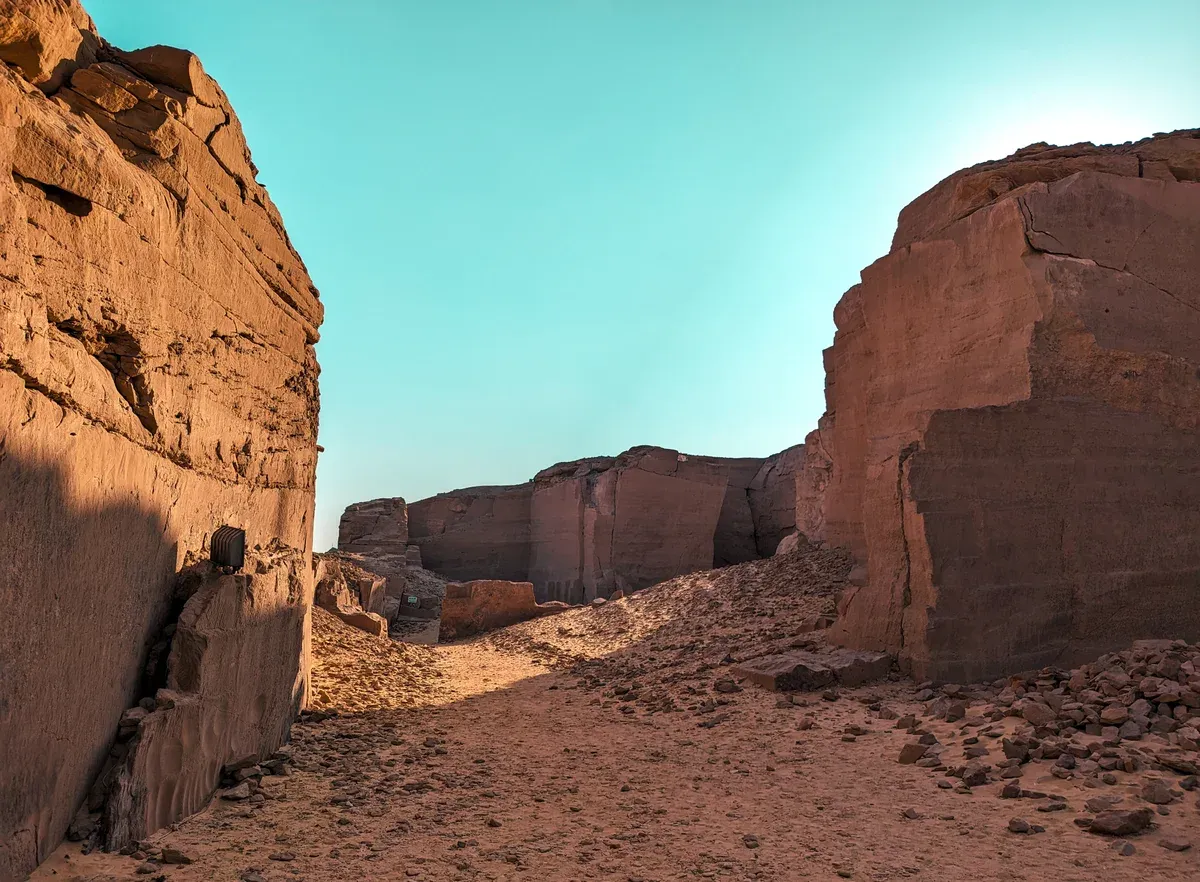
Cut sandstone walls in the ancient quarries at Gebel el-Silsila. Photo: Lars Plougmann from United States, CC BY-SA 2.0, via Wikimedia Commons
Dahabiya Cruise Questions
How much does a dahabiya Nile cruise cost?
In this comparison, the 4-day trip from Aswan to Luxor costs $1,100 per person and the 5-day private trip from Luxor to Aswan costs $1,750 per person, both with all meals on board. Both figures are the per-person card prices, and neither includes flights or hotel nights. See the 4-Day Luxury Dahabiya Cruise and the 5-Day Dahabiya Nile Cruise for what each price covers.
What is a dahabiya?
It is a shallow-bottomed river boat with two or more sails and no propeller, towed by a diesel tugboat when the wind fails, with a diesel generator on board for power. The name comes from the Arabic for the golden one, after the gilded state barges of medieval rulers. The Nile river cruise guide shows how it fits among the other boat types on the river.
Is a dahabiya better than a 5-star Nile cruise ship?
Better for a slower pace and a stop such as Gebel el-Silsila on the 4-day trip. Worse on price, since the $690 4-day 5-star cruise costs less than either dahabiya and includes Abu Simbel. Compare the trips in the comparison table before deciding.
Which direction should a dahabiya cruise sail?
Both directions are sold. The 5-day trip runs from Luxor to Aswan and the 4-day trip from Aswan to Luxor. Wikivoyage recommends starting from Aswan for a felucca trip because of the current. The Luxor to Aswan stretch is about 214 to 220 km by road depending on the source, and the river route runs through Esna, Edfu, Gebel el-Silsila and Kom Ombo.
When is the best time for a dahabiya Nile cruise?
The preferred Nile cruise season is October to February, and Wikivoyage calls November to March the most comfortable months in Egypt. Summer highs average above 40 C in both Luxor and Aswan. Note that Nile locks close from April to mid-October for water management, which can require transfers between boats, so confirm arrangements for that period. More detail is in the best time to visit Egypt guide.
What is included in the price of a dahabiya cruise?
The 5-day private dahabiya includes four full-board nights, an Egyptologist during the journey and all entrance fees between Luxor and Aswan, at $1,750. The 4-day trip includes all meals from lunch on day 1 to breakfast on day 4, entrance fees for the mentioned sites and a swim stop, at $1,100. Neither listing includes flights, hotels or Abu Simbel, and tips are extra on the 5-day trip. For what a luxury price usually adds across Egypt, see what the price includes on the homepage.